How Barnacles Choose Your Boat Hull
Barnacles don’t look impressive. They’re small, slow, and permanently stuck in place. Yet from a biological and engineering standpoint, barnacles are some of the most successful organisms in the ocean — and for boat owners, some of the most expensive.
Understanding how barnacles work explains why they attach so aggressively, grow so fast, and refuse to let go once they’ve settled in.
Barnacle larvae don’t randomly stick to boats. They use a combination of chemical, physical, and biological cues to decide where to attach.
They prefer:
- Hard, stable surfaces
- Low to moderate water flow
- Areas with consistent food supply
- Surfaces already hosting microbial life
That last point matters. A thin layer of slime or biofilm on your hull actually invites barnacles. Once that first microscopic layer forms, the surface becomes biologically “alive,” signaling that conditions are safe for permanent attachment. This is why routine hull cleaning is so important in barnacle prevention.
What a Barnacle Actually Is (Hint: It’s Not a Shellfish)
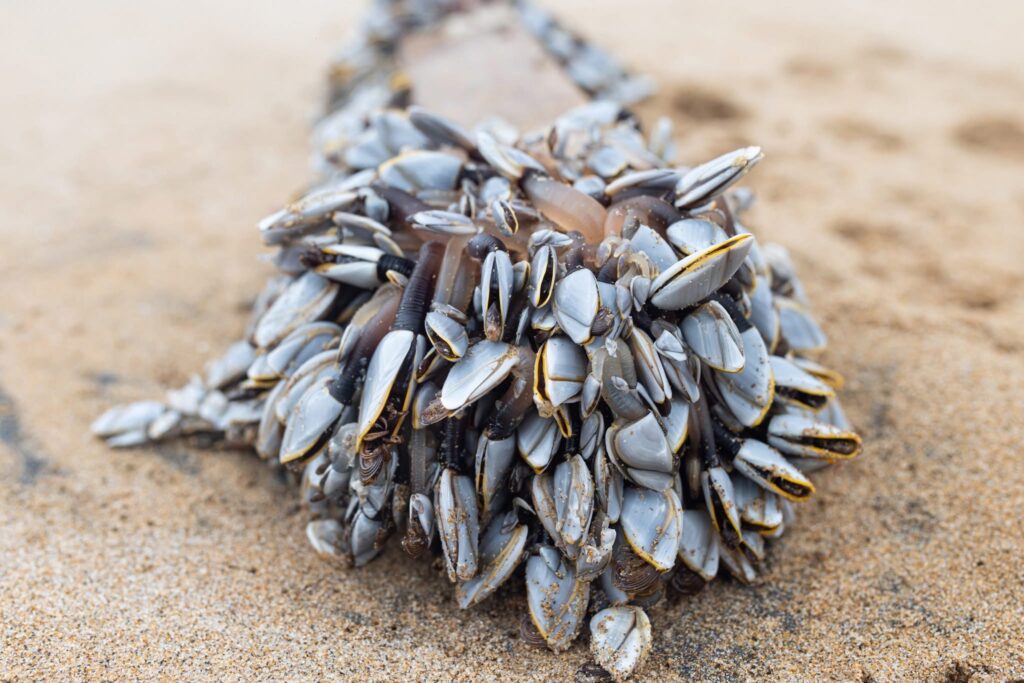
Despite appearances, barnacles aren’t mollusks. They’re crustaceans! They are more closely related to crabs and shrimp than clams.
During their life cycle, barnacles start as free-swimming larvae, drifting in the water column. At this stage, they behave like microscopic predators, feeding and moving freely. Once they find a suitable surface, everything changes.
They cement themselves head-first and never move again.
From that moment on, their entire existence depends on how well they chose their landing spot, which is why they’re extremely selective about where they settle.
The Strongest Natural Glue in the Ocean
Barnacles don’t just stick, they cement themselves.
They produce a protein-based adhesive that cures underwater, resists saltwater corrosion, and bonds to metal, fiberglass, wood, and paint. From an engineering standpoint, it’s one of the most effective natural adhesives ever studied.
This glue hardens without oxygen, resists shear forces from waves and current, maintains strength for years, and adapts to irregular surfaces.
Once cured, removing a barnacle isn’t about dissolving glue , it’s about breaking the bond mechanically, which is why improper removal damages paint and gelcoat.
Why Barnacles Love Boats More Than Rocks
In nature, barnacles attach to rocks, reefs, and pilings. Boats, however, offer something even better.
Boat hulls are consistently submerged, often stationary for long periods, smooth enough for larvae to explore, warmed by sunlight, and located in nutrient-rich marinas
Running gear is even more attractive. Props, shafts, trim tabs, and intakes experience water flow that brings a constant food supply making them prime real estate for growth

Growth Speed: Why Waiting Costs You
Barnacle attachment happens fast. In warm Florida waters such as Sebastian, Vero Beach, Fort Pierce and Melbourne, larvae can settle within hours. Visible shells can form in days, and once calcification begins, removal becomes exponentially harder.
Early-stage barnacles are soft and easy to remove without damaging paint. Mature barnacles require force, scraping, or chiseling, all of which shorten the life of antifouling coatings and expose bare substrate.
This is why cleaning frequency matters more than cleaning intensity.
Keep Barnacles From Becoming Structural Problems by Using Sunstate Marine Services for Your Hull Cleaning Needs
At Sunstate Marine Services, we understand barnacle biology, growth timing, and removal techniques that protect your hull instead of tearing it up.
Our approach focuses on preserving performance and paint life, not just knocking growth off.
Contact Sunstate Marine Services today at 772-828-1099, if your boat is in a marina in Vero Beach, Fort Pierce, Sebastian, Melbourne and the surrounding areas. Veteran Owned. Diver Driven. Sea the Difference.