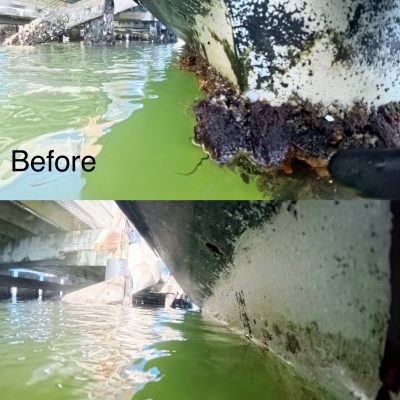
Marine biofouling, particularly barnacle accumulation, has been studied extensively for its economic impact on fuel efficiency. Less frequently discussed is the mechanical stress pathway by which hull fouling affects the engine, transmission, and drivetrain.
A marine engine does not operate in isolation. It responds dynamically to resistance imposed by the hull, propeller, and surrounding fluid. When hull roughness increases due to barnacle growth, resistance rises nonlinearly, forcing the engine to operate at higher loads for the same vessel speed. This sustained overload condition leads to increased fuel burn, higher exhaust temperatures, elevated cylinder pressures, and accelerated component fatigue. Even moderate fouling can measurably reduce vessel efficiency and accelerate engine degradation.
Hydrodynamic Effects of Barnacle Fouling on Engines
Increase in Surface Roughness
A clean hull is designed to move efficiently through water. Modern antifouling coatings create a surface that, on a microscopic level, is relatively smooth. Water flows past it with minimal resistance, allowing the vessel to achieve speed without excessive effort from the propulsion system. Barnacles fundamentally change that surface.
As they attach and grow, they increase the hull’s roughness by orders of magnitude. What was once measured in microns becomes measured in millimeters. Water no longer flows cleanly along the hull. Instead, it breaks into turbulence, creating drag that the vessel must physically push against.
That resistance does not disappear. It is transferred directly to the propeller, and from there, into the engine.
Empirical Findings:
- Light slime: +5–10% drag
- Heavy slime: +10–20% drag
- Juvenile barnacles: +30–40% drag
- Mature barnacles: +60–85% drag
Drag Increases Faster Than Most People Expect
Small changes in hull condition create disproportionately large changes in engine demand.
For example, a vessel that requires 150 kilowatts of shaft power to cruise efficiently with a clean hull may require over 200 kilowatts once moderate barnacle fouling develops. That extra power has to come from somewhere, and it comes from the engine working harder, longer, and hotter.
The engine does not know the difference between poor maintenance and heavy seas. It simply responds to load.
Engine System Stress Mechanisms
Higher propulsive demand increases brake mean effective pressure (BMEP) inside engine cylinders. Elevated BMEP causes:
- Higher piston ring loading
- Increased bearing forces
- Greater crankshaft torsional stress
Over time, this accelerates wear on main and rod bearings, pistons, liners, and valve seats.
Thermal Stress and Cooling Load
Higher fuel burn increases combustion temperature. Consequences include increased cooling system load and Reduced safety margin for overheating. The consequences also include elevated exhaust gas temperature (EGT). Prolonged operation above design EGT accelerates turbocharger degradation, exhausted manifold cracking, and oil oxidation.
| Condition | Typical EGT (°C) |
|---|
| Clean hull (Ideal) | 350–420 |
| Moderate fouling | 420–480 |
| Heavy barnacle fouling | 480–550 |
As you can see above, exhaust gas temperatures that might normally sit comfortably in the 350 to 420 degree Celsius range begin creeping toward 500 degrees and beyond under heavy fouling conditions. Cooling systems are pushed harder, oil temperatures rise, and thermal margins shrink.
These are not momentary spikes. They are sustained operating conditions that accelerate wear every hour the engine runs.
The Hidden Load on the Drivetrain
The effects are not limited to the engine block itself. As hull resistance rises, propeller efficiency drops. Increased slip forces the propeller to demand more torque from the shaft, which transfers higher loads into gearboxes, couplings, and bearings.
Over time, this additional stress alters torsional vibration patterns in the drivetrain. Components designed to operate within specific harmonic ranges are pushed outside their ideal envelopes. The result can be premature seal failures, coupling fatigue, and increased maintenance costs that appear unrelated until the root cause is examined.
Fuel Consumption Increase Stresses Engine
Empirical studies show fuel consumption increases between 20% and 60% depending on fouling severity.
| Hull Condition | Fuel Burn Increase |
|---|---|
| Clean | Baseline |
| Light fouling | +10–15% |
| Moderate barnacles | +25–35% |
| Heavy barnacles | +50–60% |
This increased fuel burn compounds engine stress by sustaining higher combustion pressures for longer durations.
Mitigation of Engine Stress Through Regular Hull Cleaning
Regular professional hull cleaning restores hydrodynamic efficiency and returns engine loading to design parameters. Studies indicate that maintaining a clean hull can recover up to 90% of lost efficiency, significantly reducing mechanical stress on propulsion systems.
Barnacle buildup is not merely a performance nuisance; it is a mechanical stress amplifier that affects every downstream component of a vessel’s propulsion system. Increased drag leads to higher engine loads, elevated temperatures, greater fuel consumption, and accelerated wear. Over time, these effects materially shorten engine life and increase operating costs.
From an engineering standpoint, regular hull maintenance is not optional but essential to preserving engine integrity, safety, and economic efficiency.
Whether you manage a recreational boat or a working vessel, regular service from Sunstate Marine Services helps lower fuel consumption, extend engine life, and prevent costly repairs.
Text or call Sunstate Marine Services at 772-828-1099 today to schedule a professional hull cleaning and keep your boat (especially your boat’s engine!) running at peak efficiency.